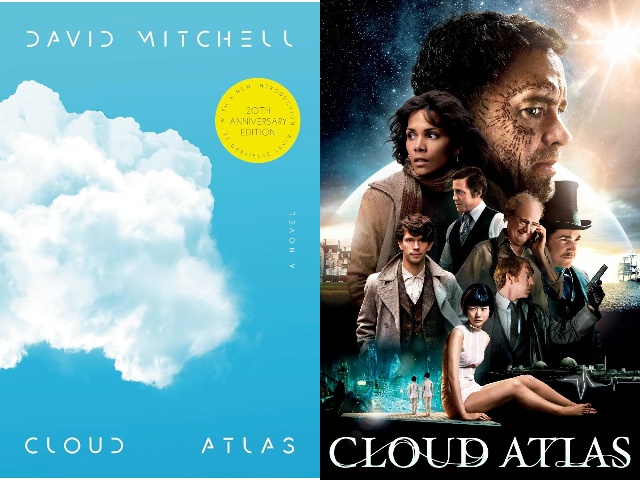
Ah, Cloud Atlas, my beloved. I read/listened to this book at the end of 2025, and I haven’t shut up about it since.
The premise itself is unique enough: six stories and six characters, all decades (and sometimes centuries) apart, with their innate connections unfolding the further you read. But it’s more than that. The depth David Mitchell gives each section, fleshing them out and making each feel so wonderfully vivid and genuine, makes Cloud Atlas a true masterpiece. Separately, each character’s tale can stand alone in success, and this is only heightened in their connections.
I adored Mitchell’s afterword at the end of my audiobook. Knowing the amount of research he put into all six sections and his inspirations for each of them enhanced every word. And the foreword by Gabrielle Zevin was also great, although I paused it halfway through when I realized it would be spoiler-y and returned to it upon finishing the book. This line of hers was my favorite: “Of course, this is how fiction works: time-travelling conversations between introverts who mostly will never meet.”
CLOUD ATLAS (2004)
The novel’s purely epistolary style is never broken, maintaining a format so singular and impressive that I wondered how a movie could ever capture it. Obviously, some of the magic would be instantly lost, as there’s no way for film to capture the individual intricacies of each section. Cloud Atlas gives us a journal, letters, book chapters, memoir pages, an interview, and a campfire tale before taking the same journey in reverse. Every story ends in media res with canonical reasons for the interruptions and continuations: Robert only has half of Adam’s journal, Luisa only has half of Robert’s letters, Timothy stops reading the Luisa book halfway through, Sonmi only gets to watch half of Timothy’s movie, Zachary’s full story is followed by the rest of Timothy’s movie, Timothy finishes the Luisa book, Luisa finds the rest of Robert’s letters, and Robert finds the other half of Adam’s journal.
Oh, it’s so delightfully mesmerizing to go over the narrators again. Half the fun is unwinding the web!
As is to be expected, Cloud Atlas is rich with excellent quotes. Sonmi’s lines about humans being connected to one another “womb to tomb” and “Time is the speed at which the past decays” are some of my favorites, alongside Zachry’s “Being young ain’t easy, cause everything that you’re puzzlin’ and angstin’, you’re puzzlin’ and angstin’ for the first time”, and Adam’s “One fine day, a purely predatory world shall consume itself.” And that last line, but we’ll get to that! Mostly, I was amazed by the quotes where the characters reference the book’s title or the cyclical nature of their existence.
Zachry: “Souls cross ages like clouds cross skies, and though a cloud’s shape nor hue nor size don’t stay the same, it’s still a cloud, and so is a soul. Who can say where the clouds blowed from, or who the soul be ‘morrow? Only Sonmi, the east and the west, and the compass and the atlas, yeah. Only the atlas of clouds.”
Timothy: “What wouldn’t I give now for a never-changing map of the ever-constant ineffable – to possess, as it were, an atlas of clouds.”
Luisa: “It’s a small world. It keeps recrossing itself.”
Robert: “When it ends, the old one plays it again, for an eternity of eternities. Time cannot permeate this sabbatical. We do not stay dead long. Once my Luger lets me go, my birth, next time around, will be on me in a heartbeat.”
Adam: “One fine day, a purely predatory world shall consume itself.”
“Yet what is any ocean but a multitude of drops?”
With all this in mind, I was curious and wildly excited to watch the movie. Surely a runtime of three hours meant that its plot would be thoroughly explored, its characters strongly developed. And many of the book’s elements would shine on the silver screen! I was in for a treat, wasn’t I?
CLOUD ATLAS (2012)
Well.
I knew I would love the movie. I just didn’t expect it to also wreck me so utterly. It’s been months, and I’m still thinking about it.
From Zevin’s introduction, I knew that the Cloud Atlas movie would be “more romantic” than the book, as well as a tearjerker. Upon finishing it, I assumed such a line referred to Robert and Sixsmith, as they’re the only solid romantic couple in the book, even if they’re never onscreen together, and they exist in a state of unavoidable tragedy. But I digress.
Going into the movie, I knew some liberties would have to be taken with the structure. Mitchell’s epistolary format couldn’t be entirely preserved. But I was still surprised by how all six stories were delivered.
The movie opens with an introduction from Zachry, then Adam, then Luisa, then Timothy, then Robert, then Somni, starting each story exactly where the book does. I loved the entire plot being given in the framework of Zachry’s tale. After we’ve met all six protagonists, we’re given fragments of each of their stories before focusing in on Adam’s – but not for long. We go from his diagnosis to Robert, right up to endearing himself to the composer, then Luisa up to leaving after first meeting Sixsmith, then Timothy up to being threatened by the brothers, then Sonmi up to Yoona’s death, then Zachary up to getting the prophecy from Abbess. From this point onward, any linear nature is lost, and the story jumps quickly between each protagonist in rapid succession.
While this format makes sense from a movie standpoint – you can’t spend your film’s runtime telling five half-stories, one full story, and then the other five halves – I couldn’t help wondering if Cloud Atlas would be understandable to a viewer who hadn’t read the source material. The book, while initially confusing, is at least chronological. The stories are divided evenly – A, B, C, D, E, F, E, D, C, B, A. In the movie, however, while the beginnings of each story are given in chronological order, the plot quickly jumps around between timelines. Certainly, a fresh-faced watcher could keep track of these timelines by remembering that they take place chronologically (starting with Adam and ending with Zachry), but with six separate plots demanding attention, this isn’t an easy task.
And because of this, the ways in which each story bleeds into the next are far more difficult to follow. In the book, the echoes of one section’s history in the present day are clear. Robert has Adam’s journals, Luisa interacts with Robert’s lover, Timothy reads Luisa’s manuscript, Sonmi watches Timothy’s movie, and Zachry worships Sonmi as their Goddess. Aside from these direct connections, there are other subtler ones: the recurring comet birthmark, of course, and then details such as Luisa listening to Robert’s music or setting foot on Adam’s ship. In this way, the connections are made crisp and easy to pick up on without interrupting or muddying the current storyline.
But since the movie has every storyline happening concurrently, these connections are harder and more confusing to track. In each chapter of the book, the reader eagerly waits for the name reveal, whereas such links are more nebulous in the movie. The brief glimpses of Luisa’s name on Timothy’s manuscript or Sonmi’s figure in Zachry’s temple are more likely to confuse rather than enlighten a newcomer. (And is it vaguely spoiler-y to know, before her death comes, that Sonmi will be deified in the distant future?)
Let’s get one major unfortunate part of this movie out of the way: the yellowface. And whiteface, too, if we’re getting specific about it.
On the surface, I really do like this concept. Having all six actors exist in every storyline as different characters, surpassing gender and race alike, is a brilliant way to illuminate the inherent connection and unity in the narrative. Is this rebirth, reincarnation, or the same story told six times?
But… ugh. When Hae-Joo first appeared, I sat up a little straighter and thought, “wait, that’s not a white guy, is it?” And then I was frantically scrolling through the cast list on IMDB and going “oh… oh no.”
The yellowface is obviously the worst and most egregious aspect, but there’s more. A black actor portrays a Maori character, Halle Berry plays a white Jewish woman and an old Korean man and an Indian woman and a Maori woman, a Korean actress plays a Mexican woman and a white woman… and the makeup is never really all that great. As I said, I get the idea behind the execution, but it still makes for an awkward watch.
2012 sure was a year, wasn’t it?
But let’s dive briefly into the minutiae. In the introductions, we first see the comet tattoo on Robert, and my initial thought was “whoa, he’s wildly attractive.” And then we had to open with a painfully romantic scene with Sixsmith, one that hurts even more when we realize this is the last time they’ll ever have together – and, as I came to realize, the only real taste of them in the whole damn movie. Gives you an idea of what you’re in for!
Sixsmith recognizes Robert’s birthmark on Luisa when they’re trapped together, highlighting their connection. Timothy’s story opens with the book critic going off the balcony with a satisfyingly graphic amount of blood. In Zachry’s section, he has Old Georgie at his ear constantly, and he experiences a dream filled with visions from every story – some we’ve already seen, and some we haven’t yet.
I initially wondered why Zachry was so much older than he was in the book, but Tom Hanks is so good it’s hard to complain. But when Meronym arrived, much younger than her book counterpart, I understood what they were going for.
Much as I was enjoying these details and jumping plotlines, I couldn’t help but wonder if the clashing tones were weakening one another. In the book, it’s easy to get invested in the vastly different stories, but does Robert’s narration lose something when it’s interrupted by Timothy’s more comedic atmosphere?
By the midpoint, however, I was enjoying the overlapping much more. It made for some excellent parallels, such as Sonmi and Hae-Joo’s escape alongside Autua proving himself on the ship, or the flooding tunnel alongside Luisa swimming out of the water. And Isaac’s lines over the climactic moments of all six characters sold me on this format entirely.
Returning to Zenin’s quote in the introduction about Cloud Atlas being more romantic in a film format, I quickly realized I was wrong in assuming this referred solely to Robert and Sixsmith. While I’d refer to them as the romantic core of the movie, they’re not the only couple. Zachry and Meronym’s relationship is less platonic than it was in the book (and their age gap is significantly changed), Adam’s relationship with his wife is more pronounced, Timothy finds Ursula again, and Sonmi and Hae-Joo have more of a love story in here than they originally did. Luisa is the only one who avoids this fate.
But Robert and Sixsmith… agh, this is what broke me.
The unstoppable tragedy of it all! That clock tower scene, the near misses, the heartbreaking timeframe of Sixsmith being so close… and it was only in that horrible bathroom that I realized Sixsmith would be assassinated in the same fashion as Robert’s suicide!
Robert’s death is closely followed by Sonmi making her speech, becoming the new God as she watches Hae-Joo die. We’re given brief glimpses of romantic happiness with Adam’s reunion with his wife, as well as Timothy and Ursula, and Zachry and Meronym. But the part where Adam’s father-in-law warns him against his abolitionist actions alongside Sonmi’s execution… chills, man. Such good stuff.
And then we get that line that gets me every time: “What is an ocean but a multitude of drops?”
I watched Cloud Atlas hoping for an action-packed, romantic, faithful adaptation of one of my new favorite books. And not only did I find this, but I was utterly blown away by the depth of emotion and tension delivered in this format.
Frustratingly, this is a hard one to recommend to friends and family. I’d urge them to read the book first to better follow the movie, but a 21-hour audiobook isn’t an easy sell. And then, even if they’re convinced to watch the film, you have to ask them to look past the yellowface. But hey, Tom Tykwer and the Wachowski sisters made a masterpiece of a movie, and the effects hold up surprisingly well! With a fantastic cast and narrative direction, I’ll always look upon this one with the utmost fondness. Mitchell’s fans have the right idea: that final line would make one hell of a tattoo!