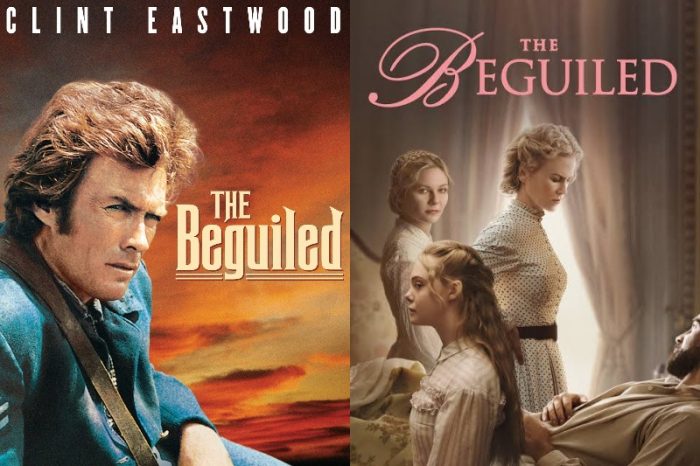
1966 introduced the world to Thomas P. Cullinan’s The Beguiled. The gothic thriller was made into a movie starring Clint Eastwood just five years later, followed by a second adaptation in 2017. Which film treated the source material better, and how good was the source material in the first place?
The sun was high now and the cannons were beginning to rumble experimentally in the woods. It seemed the battle was commencing again as I went out to notifty the others of the change in our program.
The Beguiled takes place in the midst of the Civil War at a Southern school for young ladies. When one of the students finds an injured Union soldier out in the woods, she brings him back with her. Thus begins a chain of events in which the residents – three women and five teenage girls – are worked upon by the soldier in a bid for his freedom, only for him to be used as well. Who can be trusted, how many more secrets are in hiding, and who will escape the school alive?
Despite this tense premise, I found The Beguiled painfully slow. It had moments of gothic terror, but it took a while for the plot to finally pick up. The ending was much better than I anticipated, however, and the length of the story fleshed out each woman and their relationship with McBurney very nicely.
I’ll quickly summarize the cast of characters. Corporal McBurney is the Union soldier who arrives with a wounded leg. The three women at the school are Martha, the headmistress, Harriet, her sister with a drinking problem, and Mattie, a slave woman for the family. The five girls are, in descending order of age, Edwina, Emily, Alicia, Amelia, and Marie. Edwina is rumored to have “black blood,” Emily tries to be more adult than she is, Alicia is beautiful and well aware of it, Amelia loves nature and animals, and Marie is a precocious ten-year-old eager to cause mischief.
In the book, McBurney pounces on secrets and whispers to gain the upper hand over each woman. He compliments them all, flirts with some of them, and turns them against each other until it’s clear he’s not the only one who isn’t what he seems.
Given the dreadfully slow pace of the book, I looked forward to both movie adaptations. Surely the slow-burn tension would fit better on the big screen than 400 small-print pages, right?
The Beguiled (1971)
Well, um…
This movie opens, as does the book, with Amelia finding McBurney in the woods and leading him to the school. For no reason whatsoever, 41-year-old Clint Eastwood kisses 12-year-old Amy in this scene. I have no earthly idea why this addition was necessary or approved of by anyone, especially since it’s not even in the freaking book!
So that was a gross tone-setter for what I was getting into.
My main complaint about the beguiling in this movie was how every dynamic was romantic (which led to one of the worst foursome dream sequences I’ve seen since Bram Stoker’s Dracula). Martha, Edwina, Carol, even Amy for God knows what reason. This feels like when I finally read the LXG comics and realized that the Invisible Man is a freaking saint in the movie compared to the source material. Because I’m not saying The Beguiled handled minors and their crushes perfectly well, but at the very least there wasn’t anything romantic between McBurney and Amelia! That’s explicitly stated in the book! Same with Marie, too! McBurney flirts with Edwina and Alicia and Harriet, but he doesn’t try to romance Martha, only appeal to her authority at the school. He makes these same speeches to Matty, but she doesn’t fall for them. As for Emily, she’s one of the first to see through McBurney’s airs. He attempts to flatter her intelligence, but there’s nothing sexual about their dynamic.
I really can’t believe I’m arguing in favor of the book in this case.
But yeah, ugh. It really cheapens the drama and horror when McBurney is just seeing how many women he can flirt with and seduce in the shortest timespan. Where’d the beguiling go? This is just a freaking love square!
Despite this, the rest of the movie is impressively tense. McBurney becomes a more aggressively defiant character near the end than he does in the book, but this makes the satisfaction of the ending all the more poignant.
In terms of characters from the book to the movie, we see some changes. The school population is slightly enlarged, making most of the girls background characters rather than active victims of McBurney’s manipulations. The focus is on Martha, Edwina, Hallie, Carol, and Amelia. In this movie, the characters of Harriet and Edwina are molded into one. Instead of Martha’s younger sister or the school’s oldest student, we have Edwina, the young schoolteacher. This light paring down of the core cast made sense, as well as making the movie a little less rapey. But the plotline of Edwina being biracial (or one-quarter black, assumedly) is cut out of this movie.
Matty, the slave woman from the book, is renamed to Hallie here. McBurney attempts to win her over, too, by promising to find her runaway slave husband. He almost succeeds in deceiving her, but Hallie ultimately stands up against him. It’s a bit of a change from the book, where Matty is the only one to consistently stand guard against McBurney from beginning to end.
Instead of Alice, we have Carol, the 17-year-old called a “hussy” by Edwina. Carol eagerly and shamelessly pursues McBurney – and my god, who signed off on casting Clint Eastwood for this role? He’s 41, and McBurney is supposed to be 20! This isn’t supposed to feel THIS creepy!
Ugh, anyhow. Martha also develops an attraction for McBurney, because who doesn’t at this rate? This is a great time to mention that, out of all the subplots that didn’t make it from the book to the screen, Martha having an incestuous relationship with her now-dead brother made the cut. And it’s revealed really early on, too!
Alongside that flashback, we’re treated to snippets of McBurney’s past, too. He lies frequently, such as telling Martha he’s a Quaker who doesn’t carry a gun and became wounded trying to help an enemy soldier. In these flashbacks, we’re treated to the truth of the matter.
The turning point comes when McBurney kills Amelia’s pet turtle in anger, losing his last friend in the school. The women devise a plan to rid themselves of McBurney for good. Only Edwina remains mindlessly loyal to him, ignorant of the plot surrounding her. Amelia gets her revenge, giving us a satisfying ending to the film.
While many of the intricacies and manipulations of the original text were lost, the 1971 movie is a mediocre adaptation of The Beguiled. And then there’s all the creepy underage stuff… ugh. Let’s see if forty years made any difference to the plot, shall we?
The Beguiled (2017)
Well… kind of?
First off, let’s get one major thing out of the way: Mattie, aka Hallie in the 1971 movie. She’s not in here at all, which is an… interesting choice. Yeah, I can get how making your MC an active slaveowner doesn’t look good this decade, but cutting her out entirely was a lazy move. And then there’s the added detail of Edwina being fully white! In the book, her secret biracial identity is noticed by Matty and used against her by McBurney in small ways. It’s one of the many secrets that come to light in McBurney’s beguiling and trickery. I genuinely don’t get why this plot point had to be lost, too.
But, moving on. This movie played the same card as the 1971 film, with Edwina being a schoolteacher instead of Martha’s sister or a student. Amelia remains the same, as do Marie and Martha and Alicia. Emily, on the other hand, is present but far less of an active character than she was in the book. Interestingly, instead of making Edwina a teacher and cutting down the list of students, this movie kept the number at five and added a new one: Jane, a musician. As does Emily, she plays a very small role and doesn’t have an active part in McBurney’s scheming. And that leads me into my rant: “scheming” is too harsh a word to use here!
The biggest gripe for me in this adaptation was that McBurney seemed… not as bad as he should be. Yes, he tells Edwina he loves her and then goes to hook up with the 17-year-old, but that’s it. Is that bad on its own? Absolutely. (Also, she’s 15 in the book, so, yeah.) But in comparison to his book actions and his behavior in the 1971 movie… he doesn’t come across as this master manipulator lying to everyone.
In the book, McBurney weaponizes everyone to turn them against one another. He makes dramatic, lofty declarations of friendship and romance to whichever girl happens to be present, and whenever he is caught in a lie, he turns it around to regain favor. He also drags out secrets from every woman, using them whenever needed to gain the upper hand. Things like Edwina’s background, Harriet’s drinking, Martha’s wigs, or Marie’s religion. We only get snippets from each person’s perspective, letting the reader understand how manipulative McBurney is while the girls themselves remain largely oblivious until the end. It’s satisfying to watch their illusions shatter one by one, but the most significant moment comes from McBurney killing Amelia’s pet turtle. (In the 2017 film, it’s not confirmed that the turtle dies, but he hasn’t survived any version of the story yet!) When Amelia, McBurney’s initial savior and most loyal friend, turns on him, he’s forced to realize that she’s the most dangerous person at the school. He’s the caterpillar, and the students are all the ants.
So yeah, McBurney’s actions in the 2017 film are very pared-down. He flirts with Edwina and Alicia both, as well as seemingly doing the same with Martha and Jane, but it’s not the carefully spun web of deceit from the book. He tells Amelia that she’s his best friend in the house, but it doesn’t come across as a strategy to get her on his side – it sounds genuine.
In the book, McBurney tells every girl who walks by him that she’s the prettiest, the most charming, his absolute favorite student at the school. When his compliments come across as honest gratitude in the 2017 movie, it’s hard to root for his downfall. Although I like Colin Farrell and his book-accurate Irish brogue, this version of McBurney is a weaker one.
2017’s ending doesn’t carry nearly the same weight as the book or even the 1971 adaptation. Sofia Coppola claimed she wanted to tell this story from the women’s perspectives instead of the man’s, but she ended up creating a story that lends more sympathy to the sole male character instead. Yes, McBurney snaps near the end and threatens everyone, but this action reads as a desperate attempt to regain control after his amputation, not a terrifying reveal of his true nature and intentions. Even his brief violence toward Alicia isn’t enough to fully vilify him.
The very title of The Beguiled is brought into question throughout the book. Who is the deceiver, and who is the deceived? In Coppola’s movie, the question is barely worth asking. The Misery-esque scene of terror is ripe with dread, but it swings the pendulum too far in McBurney’s favor without ever returning to the other side.
Mushrooms for dinner
I loved the moment in the book where the women collectively decided to poison McBurney without outright expressing it. The subtle acknowledgement and cooperation in their murder plot was deliciously tense, and it made sense how everyone had reached their breaking point with him. The killing of Amelia’s turtle was the final nail in his coffin.
In the 1971 movie, this subtlety is well-delivered. Martha asks Amelia to gather mushrooms for McBurney’s dinner, and Amelia, grieving her turtle, understands exactly what she needs to do. There’s also the added layer of tension with Edwina being blissfully devoted to McBurney, nearly ingesting the poisonous mushrooms herself before Martha stops her.
The 2017 film preserves this strange connection between Edwina and McBurney, although it makes sense. In both adaptations, Edwina says that she wants to leave the school, and her inexperience with men leads her to become obsessed with McBurney. Although I did prefer the teamwork in the book where all eight women came together to kill him!
But the poisoning scene is so painfully heavy-handed in 2017. After McBurney kills Amelia’s turtle and storms out, followed by Edwina, Martha tells the girls that they need to find a way to rid themselves of him. Marie all but says, “Why don’t we feed him Amelia’s poison mushrooms?” and Martha agrees. Amelia fetches the mushrooms, serves them to the corporal, and he dies. It’s… a little straightforward. The movie already foreshadowed the mushrooms earlier on; why not just cut from Marie saying “I have an idea” to dinner being served? From the ominous shots of the mushrooms to the girls convincing Edwina not to eat them, it’s obvious what’s going on!
Both movies had great music and cinematography, as well as chilling final scenes. (But the 2017 movie was far too dark. It’s not fun cupping my hand over my phone screen at full brightness and still squinting.) I’m somewhat frustrated by how many plot points Coppola borrowed from the 1971 film instead of from the book, from Edwina’s devotion to McBurney to the latter wildly accusing Martha of amputating his leg out of jealousy. It gives the 2017 film the air of a remake rather than a second adaptation of the book.
I was surprised to find, at the end of my studies, that I preferred the book ending to all else. The mutual agreement from every woman that McBurney had to die was a satisfying conclusion. Although it was somewhat painful to trudge through half the book to get to that point, I’m glad I made it in the end. I always enjoy exploring different adaptations of the same story, and the visuals were excellent in both movies (although more atmospheric in 2017). Ultimately, I wish the layered complexities of all eight women were more thoroughly explored in one of the films, but I won’t get too greedy. In the end, it’s unreasonable to expect a perfect adaptation from a fundamentally imperfect novel.