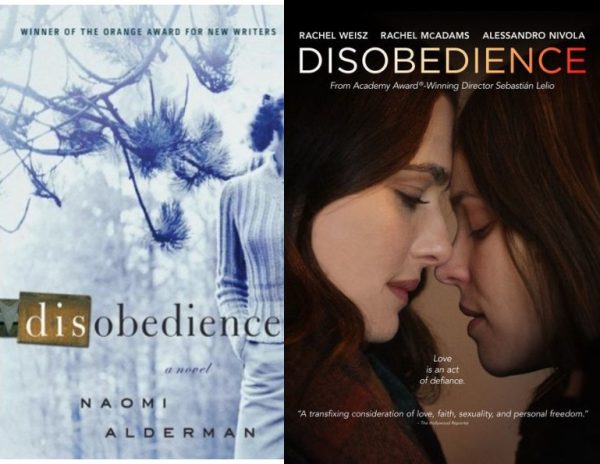
There’s nothing quite like watching a sapphic movie, enjoying it, checking out the source material, and realizing said sapphic-ness was not quite as heavy (or even present in the first place) in the OG!
*turns around to glare at Eileen*
Today, we’re examining Naomi Alderman’s 2006 novel Disobedience and the subsequent 2017 film adaptation starring the two Rachels! I originally watched the movie, checked out the book, then bounced back to the movie with my newfound knowledge. Is one version inarguably better than the other, or do both media offer their own unique –
Ha, no. There’s a clear winner here. Let’s get into the reviews, shall we?
This is a crossposted review of Disobedience from my Goodreads account. The original review can be read here.
*steeples fingers*
Okay, I…
Let’s try to be fair about this.
I was aware of Disobedience as a movie back when I was a kid, long before I knew it was a book. It was one of those sapphic films I kept a secret list of to watch when I grew up. I finally watched it in a double-feature with Daredevil in November 2022. I’m thinking of rewatching it, as that was a while back and I don’t remember many of the details. But I really liked it, I recall.
I decided to check out the book once I learned about its existence, and… it’s different. Which I didn’t know going in, which made for an interesting reading experience.
First off, this needs to be said: this book is not a romance. The movie is focused on Ronit and Esti’s love story, but the book isn’t centered around them. It’s Ronit’s story about her complicated relationship with her childhood home and religious community. Dovid and Esti are both equal side narrators.
For a while, I liked that. This book was heavy in Jewish history and culture, with each chapter starting with a certain verse or quote that would then be delved into. I also liked Dovid’s chapters, as he was a character I felt guilty for wanting more of from the movie. I’m not trying to make the f/f love story spend too much screentime on the one guy! But I liked his and Ronit and Esti’s friendship, and the book gave more details on that. Except that my favorite scene from the movie with the three of them wasn’t in here, so I’m bummed about that. (I’m talking about the hug at the end, where Dovid forsakes his “don’t touch women” reserve to include Ronit in his and Esti’s embrace. Now that was a beautiful moment!)
(Also, in the movie Ronit does photography and it’s a whole thing with her character and her relationship with her father. It was a great addition.)
As this book trudged onward, I came to realize just how different it was from the film. There are few moments between Ronit and Esti, and their relationship is barely a focus in Ronit’s journey. I can’t even really tell if she and Esti have a true bond. She’s just trying to find her mother’s candlesticks and solve her strange, tense relationship with her dead father. And that would all be valid, if not for the horribly handled sapphic themes and bizarre ending.
In the movie, Esti and Ronit frankly confess to each other that Esti is gay and Ronit is bi. In the book, while Esti is clearly a lesbian, Ronit never claims a title. She IS bisexual, as she has relationships with men and women, but her sexuality takes a backseat in her whole self-discovery adventure. And to a degree, I could’ve dealt with that – not every story about queer people has to be a romance, after all – but this gives a very strange air to the ending. Heavy spoilers ahead.
*spoilers!*
So, Ronit and Esti have sex once but don’t commit to anything between them – and it’s not even clear if either of them wants to. Ronit is built up as more of a fanciful golden standard to Esti rather than someone Esti is/was madly in love with, which makes for a disappointing end to their story.
Anyhow, after getting caught with Ronit, Esti goes on a walk with Dovid, has a nice moment with him, considers leaving, then tells him she’s pregnant. The two of them help Ronit sneak into her father’s hesped and Esti gives a strange speech to everyone, coming out as a lesbian but announcing that she won’t change herself for anyone else. But… she’s not getting divorced?
Yeah, so then the book jumps a year later. Ronit is at a new job, Esti and Dovid’s baby is named after Ronit’s dad. Esti and Dovid are still married and working together in their community. So… power couple?
The final passage of the book about “practicing” something and what that means was interesting, but it also ends with Ronit having a dream about a man – maybe it’s her father, maybe it’s a future boyfriend. It’s not clear.
In any case, this was where the book totally disappointed me. Esti being a lesbian and staying in her straight marriage was an… interesting authorial choice. I could get it happening in a tragedy, but we’re supposed to read this as Esti finding satisfaction and a sense of freedom in her life.
Based on an article by Alderman looking back on her book, she explains its ending as representative of the imbalance felt by queer Jewish people. To leave the religion and be your true self will grant you freedom, but to stay in it and deny that part of you will grant you community and comfort. Alderman says that there’s no perfect answer, as steps are being made very slowly to bring change to the Orthodox Jewish community.
But this answer doesn’t fit Ronit and Esti’s situation. As a tragedy, it would work for the two of them to be torn apart by their love, with Ronit choosing individuality and Esti choosing safety. Both of them would only live half a life, forever unsettled. But that’s not how the book ends!
Yes, Esti must suppress her sexuality to remain in her community. But Ronit isn’t losing her religion entirely by leaving it. In the end, Ronit muses on how she is coming to terms with her religious past and upbringing, finding a way to exist in both worlds as she grows. But with Ronit being bisexual, not gay like Esti, her path is more straightforward. Ronit has the option to marry a man and live a “straight” life where she could be happy, something not open to Esti. She’ll never love Dovid the way Ronit could love a man.
I read a review saying the ending would make more sense if their sexualities were switched – if Esti were bi and Ronit gay – and I totally agree. Esti being bi but still in love with Ronit would make her severing from Ronit and reconciliation with Dovid better than a gay woman stuck in a heterosexual marriage. And Ronit being a confident lesbian as she explored her relationship with her faith would make her path more clear – she’ll love who she loves without letting anyone hold her back this time.
But with the characters being as they are, this ending is very queer unfriendly, with Ronit’s bisexuality existing as a fallback for her to claim the “straight” happiness Esti never can.
Oops, that got long.
I found this excellent article by Alderman, in which she reflected on her book and the changes made to the movie as it was released. It’s an interesting read, as Alderman has, since writing her book, left her Orthodox Jewish community and appreciates the different ending given to Ronit and Esti in the film.
I was enjoying this book for the first half, but when I realized where it was going I felt betrayed. As a character arc, it almost works for Ronit, but it leaves a great deal unsatisfyingly tied-up.
Maybe I should rewatch the movie. I could only picture Rachel McAdams and Rachel Weisz while I was reading, and I love them both! It’d be a nice palate cleanser after that ending.
2.5/5 stars.