Looking back, I can’t remember when I first became aware of Kazuo Ishiguro’s Never Let Me Go. It might’ve been on Goodreads, where I saw it praised as one of the best sci-fi books of the 21st century, and then I learned it was about clones! And that, paired with my love for the strong relationship implied in the title, solidified its place on my TBR list.
The fact that it took months to claw my way up my library’s hold list for the audiobook only heightened my excitement, as such popularity seemed clearly evident of a fascinating read/listen. How delighted I was when my turn came at last!
And… well.
Do you know the feeling of being half-aware of a piece of media all your life, only to finally consume it and think “wait, it was like this the whole time?”
I remember when I watched Indiana Jones and the Crystal Skull with my family, despite my dad’s protestations. Even knowing that it was the least popular movie in the series, I was curious – but I couldn’t believe what I was seeing! Don’t get me wrong, I had fun, but how had I never known that this movie had aliens?? I’m still amazed that I went so long in ignorance, and it’s odd to look back at my pre-watch thoughts towards the movie knowing what I do now!
And that’s how I feel about Never Let Me Go. I’m left reflecting on my excitement for the book, my adoration of that title and the premise of clones, and wondering how I never knew that the book would be so… dull.
In a way, I get it. I do! There’s something poignant and impactful about writing a terrifying, cruel, dystopian future and choosing instead to focus on the tragedy of the young souls so enmeshed in their reality that it serves only as a background to their personal struggles.
But on the other hand… how is a book about cloned children raised solely as organ donors so boring?
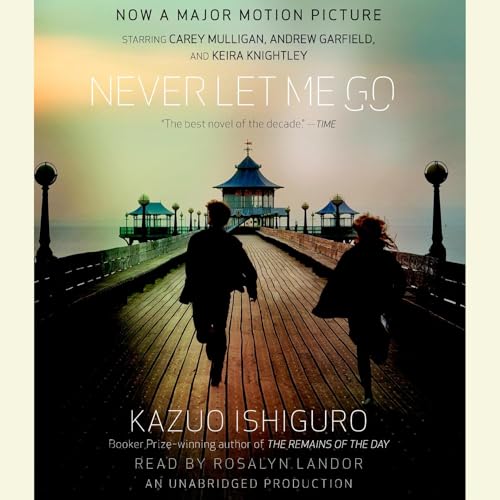
The romance was exhausting, but I’ll get to that. The book’s sci-fi backdrop and the small and large details of its worldbuilding are frustratingly unclear, not to mention so understated that they feel disappointingly irrelevant. There isn’t even the feeling of a greater evil pressing down on the edges of the characters most of the time!
And that could’ve worked for me. As I’ve said, I really do like the premise of a dystopia with no rebellion, no massive war, no seismic shift, no semblance of victory. Instead, it’s just about three young people damned to be crushed beneath the wheels of society, learning far too late the role they played in a failed resistance movement.
And oh, what I would’ve given for these three to be more interesting.
We have Kathy, Tommy, and Ruth, clone children raised at Hailsham for organ harvesting, and all the book consists of is their stupid, vague love triangle. (Though it’s far less annoying in the book than the movie – more on that later.) The three of them are friends growing up together, then Tommy and Ruth start dating offscreen. They have some drama, but they stay together, with Kathy trying to be loyal to both of them, and then their paths take them in different directions as they age. Kathy finds Ruth again years later, having long parted ways with Tommy, and when the two of them reconnect with their third part, Ruth reveals that she dated Tommy because she was jealous of his and Kathy’s bond and didn’t want to be alone. She dies, then Kathy and Tommy get together offscreen, Tommy eventually dies, and Kathy is set to be next.
(I really think the three of them should’ve just all dated each other and solved their problem, but that’s neither here nor there.)
Writing this down almost makes me appreciate the book a bit more. There truly is something poignant about the characters not even focusing on their damnations, concerned only with their personal lives. But my reading experience was such a slog that I’m reluctant to give Ishiguro that much credit. I genuinely believe you could rewrite this book in the real world, with the three of them having terminal illnesses, and the story would remain much the same.
(Also, while this was fully my fault, the author’s name made me mistakenly assume this book would be set in a futuristic Japan. But no, Ishiguro grew up in England, so the setting makes sense, even if it was a letdown.)
However, despite being so underwhelmed by the book, I heard that those who went blindly into the movie of Never Let Me Go were brought to tears. And the film certainly had a stacked cast! So I was naturally curious to see if the movie delivered the emotion missing from the book. With only five years between Never Let Me Go‘s initial publication in 2005 and the movie release in 2010, the story was certainly fresh in the public eye!
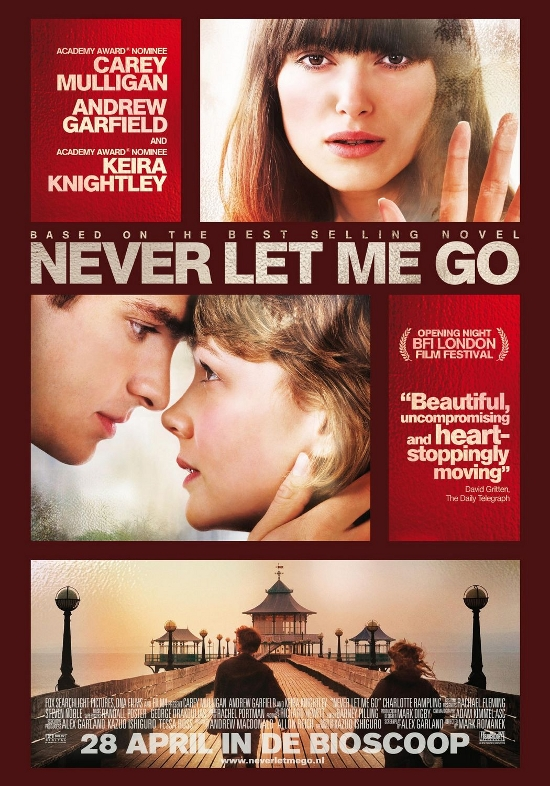
Overall, Never Let Me Go pushes two parts of the book into the light with blunt delivery: the horror of the students’ fates and the tragic romance between Kathy and Tommy.
I appreciated how well the movie set the story’s atmosphere, from opening onto a “donation,” to emphasizing that the Hailsham students have to remain healthy, to the kids being treated badly outside, not welcomed back to school if they try to leave. And with a terrifying dystopian future taking place in a normal-looking British countryside, the effect is strongly felt.
As in the book, the movie keeps Kathy and Tommy firmly at the forefront. However, I was surprised and disappointed by how badly Ruth was handled. In the book, yes, she’s selfish and impulsive and doesn’t have the smoothest romance with Tommy. But she’s still Kathy’s best friend, and the bond between the three of them is given the most emphasis. When Ruth and Tommy fight, Kathy hesitantly tries to help them but says she doesn’t want to intrude. Ruth tells her that no, Kathy isn’t intruding, because she’s as much a part of their relationship as they are.
Such sentiment is lost in the movie.
Part of the tragedy of Kathy and Tommy’s story is that they only realize far too late that they loved each other. In the book, Kathy doesn’t go through her childhood painfully yearning for Tommy, which makes their relationship development hit all the harder. But in the movie, Kathy is deeply and consciously in love with Tommy from their earliest meeting. She mourns Ruth getting to him first, wonders if she should’ve behaved differently to attract him, and distances herself from the couple.
Even the song which titles the book is changed. In the book, Kathy dances to “Never Let Me Go” and imagines a woman holding a baby. When she loses the tape, Ruth gifts her a different one, and Tommy eventually helps her find a new copy. In this way, the song ties Kathy to both her friends.
But in the movie, Kathy longingly listens to this song when she’s forced to watch Ruth and Tommy together, specifically the line “kiss me.” And Tommy is the only one to help her when she loses it!
Tommy doesn’t fare any better here. While, yes, his and Ruth’s relationship is volatile in both formats, he seems to actively dislike her in the movie, not even enjoying sex with her! And his obvious crush on Kathy the whole time makes it mind-boggling that he’d remain with Ruth for so long.
Oh, and don’t get me started on the worst scene. Both the book and movie include a part where Ruth tells Kathy that, if she does end up breaking up with Tommy, Tommy doesn’t like Kathy like that. It’s cruel both times, but not quite so harshly in the book. There, the two of them are still young, and Ruth is desperately trying to cling to both Tommy and Kathy by keeping them apart and linked solely through her. In the book, she’s not kind, but she’s not quite so conniving as she is in the movie! This time, Ruth goes to Kathy after sleeping with Tommy and harshly tells her that Tommy will never choose her. The fact that everyone is far older this time around makes Ruth feel more cold and less lonely. But Ruth quickly kissing Kathy before running out is the only improvement on this scene.
While Never Let Me Go didn’t make me cry, I was on the lookout for tear-jerker moments, wondering which callback would return. I thought that the Hailsham school song would make a reappearance, with Kathy singing it to Tommy before he died. But no, it’s Tommy’s screaming rages that come back around to painful effect.
Funnily enough, writing this is helping me understand the book more and more. I definitely like its ending over the movie’s – “to drive off to wherever it was I was supposed to be” is an unbelievably painful closing line.
It’s one thing to feel wistful and regretful over a dystopian story where the heroes came so close to winning the day and saving the world. It’s wholly another to realize they not only never had a chance; they never had the means to fight back. Never Let Me Go is a romance first, science-fiction second, and that is where its true tragedy lies.