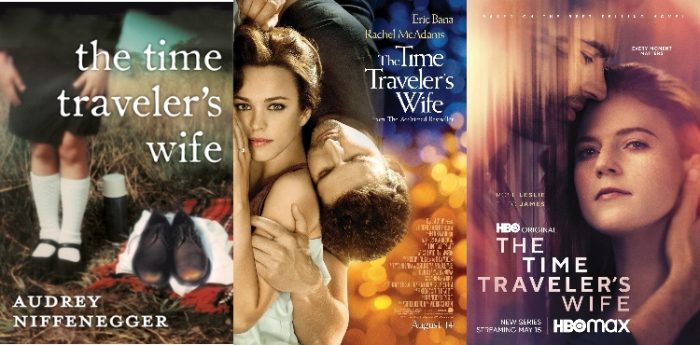
The Time Traveler’s Wife – BOOK (2003)
Dead people need us to remember them. Even if it eats us. Even if all we can do is say ‘I’m sorry’ until it is as meaningless as air.
I remember when I first became aware of the existence of The Time Traveler’s Wife. It was in a now-nonexistent mall library in the racks of audiobook CDs. It was the single word “unabridged” on the case that stayed in my memory. “Abridged” sounded like an honor given only to classical tomes, and so TTTW stayed in the back of my mind for well over a decade. Recently, I had the random urge to check it out of my local library, as I knew its popularity and considered it a modern classic. Completing the loop, I finally read it as an audiobook this year.
And… I mean, it had its moments.
“Our love has been the thread through the labyrinth, the net under the highwire walker, the only real thing in this strange life of mine that I could ever trust.”
The Time Traveler’s Wife is an impressive feat. Audrey Niffenegger times the novel well, titling each chapter with Henry and Clare’s respective and constantly shifting ages. As they fall in love in reverse, all out of order, we slip between their perspectives to maintain a chronological timeline and give some semblance of direction to us the reader.
But obviously – and I’m not alone in saying this – there’s an undeniable creepiness factor accompanying many of the couple’s interactions. Henry is a full-grown adult when he first meets 8-year-old Clare, and in the many times he visits her as a child, he’s always in his thirties or forties. As the reader, we know this isn’t a grooming situation and that Henry has no ill intentions toward young Clare. But the bizarre implications of these visits are difficult to ignore – especially when they first have sex on Clare’s 18th birthday when Henry is 41.
Thankfully, these uncomfortable chapters eventually die out as Clare and Henry continue to age. The escapades of their life together as Clare deals with Henry’s unpredictability are more enjoyable to read, and the time-travelling elements are truly a delight. It’s a fascinating look at a supposed superpower as a significant personal detriment.
“I love you always. Time is nothing.”
“Years, minutes, same thing,” Henry tells Clare. For him, this is true. For her, she is always the one left behind.
I very much liked how Henry interacted with his childhood self as a guide, initially pretending to be a different time traveler to give himself the impression of a secret society. This line in his discovery was my favorite: “It was as though Robinson Crusoe discovered the tell-tale footprint on the beach and then realized that it was his own.”
But aside from the mentoring, this book surprised me delightfully by acknowledging the awkwardly obvious question brought about by visiting your alternate self. A la Mickey 17, we actually have a scene of two teenage Henrys having sex together. Unexpected, yes, but I loved shoving this latent possibility out into the open!
The best part of the book, in my eyes, was when Henry told Clare he’d travelled back to his mother’s death dozens of times, becoming everyone from the bystanders to the man draping a coat around his own shoulders. And Henry almost missing his wedding and reappearing older, then vanishing and returning in the middle of Alba’s birth… such cool concepts.
But TTTW quickly drew on my patience with the very thing that held its plot together: the love story focus. We get Clare’s fun friendships with Celia and Charisse, and Henry’s male bonds with Gomez and Ben. The couple’s journey to parenthood offered more novelty to their romance, but I wanted more touches from their platonic bonds, especially Henry’s. And then there’s… Gomez.
Why did he have to be in love with Clare?
This irritation of mine tainted every interaction these two had. Sure, they sleep together once while Clare’s missing Henry, but that’s… not the worst thing. Yeah, you guys are both being terrible to Charisse, but she and Gomez are only dating at that point. The next time they sleep together is years later, when Clare is mourning Henry, and she and Gomez have sex on top of the kitchen table where Charisse just gave their kids breakfast. And then Gomez has the nerve to be hurt when Clare says Henry’s name! You are both TERRIBLE people, and this scene is so gross for so many reasons!
So yeah, ugh, wish that scene wasn’t there, especially so close to the end of the book, making it in linger in my mind!
But there are many genuinely funny moments, such as this exchange when Clare is going into labor:
“Henry, why did we decide to do this again?
“Supposedly, when it’s over, they hand you a baby and let you keep it.”
“Oh, right.”
The ultimate frustration of the book comes from Clare’s role in the story. As the titular time traveler’s wife, she’s frequently a passive observer. Having known Henry her entire life, she’s so wrapped up in him that she often fails to have much of a life for herself. The worst part of this comes after Henry’s death, when she’s in a depressed haze. Henry leaves a letter telling her that her waiting is over, that it’s time for her to live her life fully, but then ruins this whole effect by adding that he’ll see her again one last time when she’s an old woman. And the book ends on this note, with their final reunion, instead of focusing on Clare’s restarted life. The Odyssey quote at the close was nice, but it maintained the standard of Clare and Henry being so utterly defined by one another that they cannot exist separately. And yeah, I guess that’s fine enough for a romance, but it’s always so intense.
What am I doing? What have I allowed myself to become? An answer comes of sorts: You are the traveler now.
I enjoyed the Alba chapters with Henry interacting with his daughter and meeting her all out of order even after his death. Makes me wonder if we’ll ever get that The Other Husband book Niffenegger keeps talking about with grown-up Alba!
“Once upon a time – ”
“When was that?”
“All times at once. A long time ago and right now.”
“Both?”
“Yes. Always both.”
I’m glad I read this book. As I said at the beginning, it’s a feat to arrange Clare and Henry’s timelines so precisely. I give it 3.5/5 stars. But, as does every successful book, The Time Traveler’s Wife soon expanded beyond its pages. We have both a movie and TV show based upon it. Do either of them measure up or even improve upon the source material?
I sip my coffee and try to feel time revert. Try to erase the difference between now and then. It is only my memory that holds me here.
The Time Traveler’s Wife – MOVIE (2009)
After finishing the book, I looked up the movie and thought, “wait, wasn’t Theo James in this?” And then I was disappointed for multiple reasons, both that I’d been denied Theo James and that this sprawling book had been contained to a movie. There’s so much to it over such a long and winding timespan, so how could you deliver all of it in 108 minutes? Wouldn’t a TV show be better?
Well, it turned out I was half right. Yes, there is a TV show of the book from 2022, and it stars Theo James! So I had that to look forward to – but first, the movie.
2009’s The Time Traveler’s Wife has Eric Bana as Henry and Rachel McAdams as Clare. I hadn’t seen Eric in anything prior to this, so I could see him as Henry. But Rachel… no shade to her, she’s great, but I’ve seen her in so much stuff that I couldn’t picture her as Clare. (And the lack of red hair didn’t help.)
The movie had a good opening, starting us off with Henry and his mother driving in the snow, making the unfortunate choice to sing “Jingle Bells” right before the accident. Young Henry time-travels out of the car, and older Henry shows up to quickly explain who he is and what just happened before vanishing. It’s an on-the-nose introduction, but you’ve gotta start somewhere.
I already mentioned the weird grooming atmosphere the book has in the scenes with adult Henry and child Clare, but they feel even more apparent when you’re seeing them on the big screen. Henry telling Clare they’re going to be good friends right before vanishing… egh. This always would’ve been a hard scene to shoot, but maybe you could’ve phrased that differently?
I liked Gomez’s role in the movie and his friendship with Henry. Given the time constraints, Gomez’s decades-long obsession love for Clare was cut out, for which I was relieved. The bonus content for this movie explained the book scenes they decided to leave out, such as Henry getting trapped in the cage or having sex with himself, for the sake of the audience’s understanding. (Also, I learned that Eric Bana is Australian.) It was nice to see how much the creators and cast appreciated the original book and their attempts to do it justice.
Ultimately, the movie is weakened by the story being reduced to little more than a conflict-free romcom. Darker scenes such as Ingrid’s suicide and Clare’s assault are eliminated, giving the film a much lighter feel than the book. I understand these changes, given the time constraints, but it still felt more like a retelling than an adaptation.
But hey, we got the scene of Henry beating up the homophobe, so I honestly can’t complain. That part was killer.
We also get Alba and her own time-travelling-ness, which made for some nice father-daughter scenes. The movie’s ending is changed somewhat from the book’s, though. In the book, Henry never appears to Clare again after his death until she’s an old woman, but he appears to Alba many times. In the movie, when he appears to Alba, she calls for Clare and she’s able to arrive in time to embrace and talk with her husband before he vanishes once more. Yes, it’s inaccurate, but I genuinely liked seeing them having their brief reunion. Clare walking back through the field with Alba and accepting the tenuous nature of having Henry in her life was a fine ending.
But this movie was not well-received by critics nor fans of the book. So, thirteen years later, they were given a second chance…